Hand-Drawn Craft
MasteredInsists on hand-drawn key animation; reviews every frame personally.
How it developed
Decades of inbetweener and animator work before becoming a director.
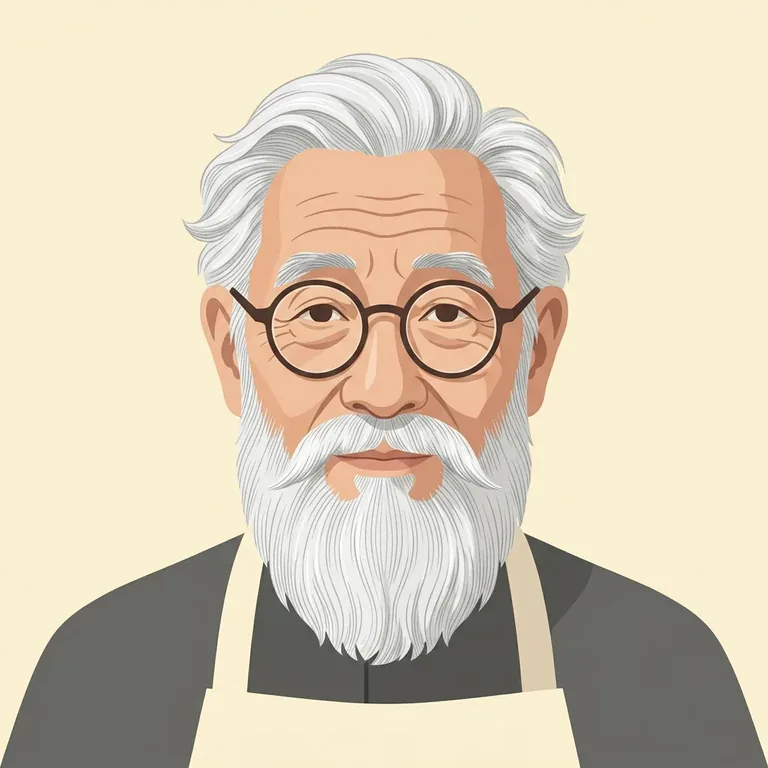
Co-founder of Studio Ghibli, animator and director.
A Japanese boy who grew up watching his country rebuild from war and turned a lifetime of pacifist guilt, ecological grief, and obsessive drawing into the most universally loved animated films ever made.
Every story has the highlights. This is the boring middle, the doubts, and the moments that quietly changed everything.
Father ran an aircraft factory during WWII that made parts for Zero fighter planes.
Childhood marked by Allied bombings; mother had spinal tuberculosis.
Childhood under conflict can produce art that is both anti-war and full of flying machines.
Watched the Toei Animation feature Panda and the Magic Serpent and was overcome.
Animation was not a respected career in postwar Japan.
One film can be the moment your life turns.
Started as an inbetweener on Wolf Boy Ken.
Bottom of a strict studio hierarchy.
Start at the base of the craft pyramid even when you have ambitions for the top.
Began the partnership on Horus, Prince of the Sun that would define both their careers.
Finding a collaborator with equal craft commitment.
Your work is shaped most by who you choose to work next to for decades.
Active in the Toei animators' union; deepened lifelong political consciousness.
Organizing in a culture that punished dissent.
Craftspeople benefit from the same labor protections as any other workers.
His first feature; later cited by Spielberg and Pixar as a touchstone.
Working within a franchise's commercial constraints.
Franchise work teaches discipline that auteur work can't.
Released the manga and film that previewed his ecological themes.
No studio support — he serialized the manga himself for years.
Some auteur visions need a self-published phase before any studio will buy them.
Founded the studio with Takahata and producer Toshio Suzuki.
Building a creator-led studio in an industry of work-for-hire houses.
When the institution you need doesn't exist, build it with the people you trust.
Two of his and Takahata's most enduring films released back-to-back.
Pairing a children's fantasy with a wartime tragedy as the same ticket.
Audiences can hold opposite tones if the storyteller can.
Became the highest-grossing Japanese film of all time at release.
Heavy environmental and historical themes in a kids-genre wrapper.
Don't dilute the message because the form is animated.
First non-English-language film to win Best Animated Feature.
Skipped the ceremony in protest of the Iraq War.
Show up with your values louder than the prestige.
Said he would stop making features after The Wind Rises.
Letting go of the craft that defined his life.
Some retirements are honest; some are pauses.
Came out of retirement to direct one more feature; won the Best Animated Feature Oscar again.
Operating at 82 with the same hand-drawn standards.
Don't trust your own retirement announcements.
Skills aren't talents — they're the residue of a thousand decisions. Here is what compounded over a lifetime.
Insists on hand-drawn key animation; reviews every frame personally.
Decades of inbetweener and animator work before becoming a director.
Builds ecosystems and cultures so detailed that fans map them like real places.
Lifelong reading in mythology, history, and ecology.
Allows long quiet scenes where 'nothing' happens — a deliberate counterweight to action.
Conscious decision to let audiences breathe inside his films.
Treats nature as a character with its own agency in nearly every film.
Hiking and birdwatching that informs his concept design.
Often skips a script and storyboards films directly, discovering the story as he draws.
Working with Takahata, who modeled rigorous pre-production.
Trains young animators by raising the bar until they meet it.
Five decades of running a studio.
No journey is a straight line. The setbacks weren't detours — they were the route.
Decades-long creative tension with his closest collaborator.
Honored Takahata publicly at his funeral with one of the most-quoted eulogies in Japanese cinema.
Long partnerships contain decades of disagreements you don't dissolve over.
Announced retirement after Princess Mononoke, after Spirited Away, and after The Wind Rises.
Came back each time with more ambitious work.
Don't trust your own retirement; let the work decide.
Strained relationship as Goro entered animation under Ghibli's shadow.
Eventually collaborated; relationship slowly repaired in public.
Family inside the same craft is the hardest collaboration of all.
The books on the shelf, the people they studied, the ideas they kept returning to.
Ursula K. Le Guin
Cited as a primary influence on his fantasy worldbuilding.
Hayao Miyazaki
His own collected essays and interviews.
Hayao Miyazaki
Second volume of his essays, covering the Spirited Away era.
Antoine de Saint-Exupéry
Childhood favorite he has cited many times.
Interviews, keynotes, talks, and documentaries — chosen for the moments that reveal how they actually thought.
The bets that, made differently, would have written a different life.
AI-distilled takeaways, sorted by who you are and what you're building toward.
Resist the algorithmic pressure to compress every beat.
If the market won't fund your standard, build a studio that will.
The proof-of-concept you need is often something you have to make alone first.
Walk the floor; review the work in person.
Trust the next idea before you trust the goodbye.
The questions most people have after studying this life. Tap one — every answer is built from Hayao Miyazaki's own timeline, decisions, books, and lessons on this page.
Adjacent journeys, a collection that frames the craft, and one pick from a different world.

A British-American director who self-financed his first feature on weekends, won the right to make IMAX-scale event films on his terms, and proved that mainstream audiences will pay full price for ambitious ideas.
Read Journey
A pre-med kid from Mount Vernon who almost flunked out of college before finding theatre — and built one of the most uncompromising acting careers in American cinema by refusing to chase fashion.
Read Journey
One of the most influential product visionaries in history — a relentless editor of ideas who insisted technology should feel human.
Read Journey
A Maine kid raised by a single mother who fished his discarded manuscript out of a trash can — and went on to publish more books than most authors read in a lifetime by treating writing as a job.
Read Journey
Writers, directors and authors who built worlds readers and viewers refuse to leave. The craft of carrying an audience through a thousand pages or three hours of darkness.
Open CollectionFive years of submitting short fiction to magazines that mostly ignored me. The acceptance, when it came, was for the piece I almost didn't send.
Read Story
Founder of Tesla & SpaceX
An obsessive engineer betting on rockets, electric cars, and the impossible — applying first-principles thinking at planetary scale.
Open Journey