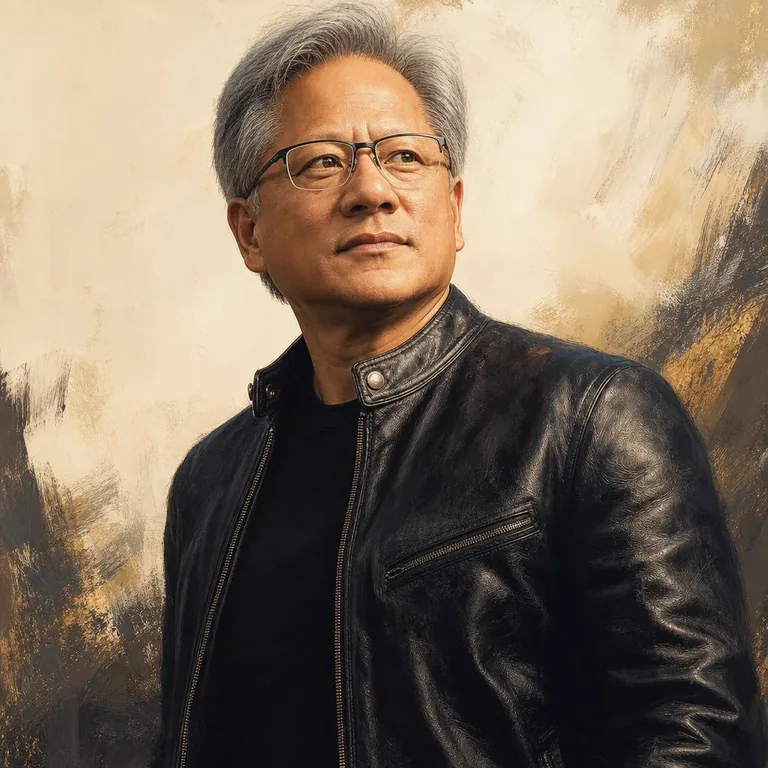
Illustrated portrait of Jensen Huang
Journey
A life, end to end

Jensen Huang

Founder & CEO, NVIDIA.

The Denny's busboy who bet thirty years on parallel computing — and turned a 1990s graphics card maker into the most strategically important company of the AI era.

Birth Year
1963
Industry
Semiconductors & AI Computing
Country
United States (born Taiwan)
Key Achievement
Founded NVIDIA in 1993 and led it through three decades of near-death experiences to become the platform layer for modern AI — and one of the most valuable companies on earth.
Life Timeline

The full arc, year by year.

Every story has the highlights. This is the boring middle, the doubts, and the moments that quietly changed everything.

  1. 1963

    Born in Tainan, Taiwan

    Family moved to Thailand when he was 5, then sent him to relatives in the US at 9 to escape Bangkok unrest.

    Challenge

    Arrived in Kentucky at age 9 with limited English; placed in what was effectively a reform school by mistake.

    Lesson

    Early disorientation builds a tolerance for uncertainty that no business school can teach.

  2. 1972

    Sent to Oneida Baptist Institute, Kentucky

    Spent two years at a religious boarding school where he cleaned toilets and learned to play ping pong — both with intensity.

    Challenge

    A 9-year-old immigrant boy among older students at a strict institution.

    Lesson

    Pick a task no one else wants and do it better than anyone else.

  3. 1984

    Graduated from Oregon State with EE degree

    Met his future wife Lori in class; he convinced her to date him by promising he'd be a CEO by 30.

    Challenge

    Standing out in a public engineering school during the rise of personal computing.

    Lesson

    Set the audacious goal out loud; some people will hold you to it.

  4. 1985

    Started as a chip designer at AMD

    His first job designing microprocessors; learned the silicon stack from the bottom up.

    Challenge

    Being the youngest engineer in a room of veterans.

    Lesson

    Pay your dues at the deepest layer of the stack before you try to build on it.

  5. 1993

    Co-founded NVIDIA at a Denny's

    Founded with Chris Malachowsky and Curtis Priem in a San Jose Denny's booth; bet on 3D graphics for PC games.

    Challenge

    Entering a market with 30+ competitors and no clear standard.

    Lesson

    If the market is crowded, your conviction has to be sharper, not broader.

  6. 1995

    First product NV1 was a commercial disaster

    NV1 used quadratic texture mapping just as Microsoft committed Windows to triangle-based DirectX. NVIDIA almost died.

    Challenge

    Watching the entire premise of the company become obsolete in eighteen months.

    Lesson

    Bet-the-company decisions sometimes look obviously wrong in retrospect. Survive the lesson and move.

  7. 1997

    Saved by the RIVA 128 launch

    Released RIVA 128, a triangle-based chip rushed to market in 9 months — the company had less than 30 days of cash when it shipped.

    Challenge

    Shipping a complete chip redesign before payroll ran out.

    Lesson

    Pace and survival are the same word in a near-death sprint.

  8. 1999

    Invented the GPU with GeForce 256

    Coined the term 'GPU' and shipped the first single-chip 3D processor; NVIDIA IPO'd the same year.

    Challenge

    Establishing GPU as a category, not just a product.

    Lesson

    Naming the category you sell into is a strategic act.

  9. 2006

    Launched CUDA — and bet a decade on it

    Released the CUDA parallel-computing platform that let scientists program GPUs for general workloads. Wall Street hated the investment.

    Challenge

    Investing billions in a market that didn't exist yet, against analyst objections.

    Lesson

    The platform bets that change everything look unjustifiable for a decade.

  10. 2008

    Survived the financial crisis and a manufacturing defect crisis

    Faced a class-action lawsuit over defective laptop GPUs and a collapsing market simultaneously.

    Challenge

    Restructuring during a global crash while paying out settlements.

    Lesson

    Multiple crises at once is the founder's normal mode in deep tech.

  11. 2012

    AlexNet won ImageNet using two NVIDIA GPUs

    Geoffrey Hinton's students proved deep neural networks worked on consumer NVIDIA cards. CUDA suddenly had its killer app.

    Challenge

    Recognising that the next decade had begun and re-pointing the company toward it.

    Lesson

    Patience plus optionality means you're already positioned when the wave hits.

  12. 2016

    Delivered the first DGX-1 to OpenAI

    Hand-delivered an early AI supercomputer to OpenAI's office — signing the box.

    Challenge

    Investing heavily in AI infrastructure when most enterprise customers still bought gaming chips.

    Lesson

    Show up in person for the customers who are about to define your next decade.

  13. 2020

    Announced $40B Arm acquisition (later abandoned)

    Tried to acquire Arm from SoftBank; regulators blocked the deal in 2022 after two years of effort.

    Challenge

    Walking away from the most ambitious deal in semiconductor history.

    Lesson

    Sometimes the right move is to lose the deal and keep the strategic relationships.

  14. 2023

    AI boom drove NVIDIA past $1 trillion market cap

    Generative AI demand outstripped supply; NVIDIA became the indispensable supplier of every major AI training run.

    Challenge

    Allocating constrained supply across customers all claiming priority.

    Lesson

    When demand inverts overnight, allocation discipline is the new strategy.

  15. 2024

    Crossed $3 trillion market cap

    Briefly became the most valuable company in the world; described it as 'an unbelievable year' on his earnings calls.

    Challenge

    Sustaining culture in a company that had to scale headcount and revenue simultaneously.

    Lesson

    Hyper-growth tests the culture you built before anyone needed it.

Skills Acquired

What they learned to do well.

Skills aren't talents — they're the residue of a thousand decisions. Here is what compounded over a lifetime.

Long-Horizon Bets

Mastered

Invests in platform shifts (CUDA, AI, robotics) a decade before they pay off — and defends them through quarterly pressure.

How it developed

Survived three near-death experiences; learned that comfort kills companies faster than crises.

Direct Reports at Scale

Mastered

Famously has 40–60 direct reports — flat organisation that demands relentless personal pace.

How it developed

Refused traditional org structure because he didn't want hierarchy filtering reality.

Operational Detail

Mastered

Reads weekly status emails from every team; can recall yield rates and supply contracts in shareholder Q&A.

How it developed

Treats CEO as engineer-in-chief, not figurehead.

Public Storytelling

Mastered

GTC keynotes are part-product launch, part-state-of-the-AI-industry address; shaped how the field talks about itself.

How it developed

Realised early that NVIDIA's customers were as much building belief as buying silicon.

Resilience

Mastered

Has lost the company multiple times — almost-dead three times in the 1990s — and rebuilt each time.

How it developed

Personal philosophy: 'I hope you'll suffer.' Hardship as preparation, not punishment.

Customer Obsession in Deep Tech

Mastered

Visits major customers personally; hand-delivered the first DGX-1 to OpenAI.

How it developed

From decades of selling specialised hardware where one missed customer signal cost a year.

Failures & Challenges

The chapters most pages skip.

No journey is a straight line. The setbacks weren't detours — they were the route.

NV1 chip disaster (1995)

Context

First product used quadratic texture mapping just as Microsoft standardised on triangles; instant obsolescence.

Recovery

Sprinted to ship RIVA 128 in 9 months with less than 30 days of cash; the chip saved the company.

Lesson

If the platform shifts under you, build a different boat — fast.

Mobile chips (Tegra) failed to gain smartphone share

Context

Invested heavily in Tegra to compete with Qualcomm; lost the smartphone market badly.

Recovery

Repurposed Tegra for cars and Nintendo Switch; the IP eventually became the basis for automotive AI chips.

Lesson

A failed market entry can produce a strategic capability if you refuse to write off the IP.

2008 GPU manufacturing defect crisis

Context

Faulty solder caused laptop GPU failures; led to a major class-action lawsuit and reputational damage.

Recovery

Took the charges publicly, paid out, and rebuilt manufacturing QA.

Lesson

Hardware crises require visible accountability; cover-ups compound the damage.

Failed $40B Arm acquisition (2020–22)

Context

Regulators blocked the deal after two years of effort; lost goodwill and management bandwidth.

Recovery

Walked away cleanly; preserved partnership with Arm; pivoted to organic CPU strategy with Grace.

Lesson

A deal that doesn't close can still teach you what to build next.

Books & Resources

The library that shaped them.

The books on the shelf, the people they studied, the ideas they kept returning to.

The Nvidia Way

Tae Kim

The most thorough institutional history of NVIDIA, with deep access to Jensen and his executives.

Chip War

Chris Miller

The geopolitical context NVIDIA now operates within — required reading for understanding the company's strategic position.

Only the Paranoid Survive

Andy Grove

Jensen has cited Grove's framing of strategic inflection points as his core operating model.

Surfaces and Essences

Douglas Hofstadter & Emmanuel Sander

On analogy as the engine of cognition — a book Jensen recommends to engineers learning AI.

Genius Makers

Cade Metz

On the AI researchers who shaped the era — Jensen and NVIDIA recur throughout.

Videos & Documentaries

Watch them in their own words.

Interviews, keynotes, talks, and documentaries — chosen for the moments that reveal how they actually thought.

Key Decisions

The forks in the road.

The bets that, made differently, would have written a different life.

Betting NVIDIA on CUDA (2006)

Risk · Extreme
Why
Believed parallel computing would eventually have a workload beyond graphics.
Outcome
CUDA became the de-facto platform for deep learning a decade later.
Long-term impact
Made NVIDIA the platform layer for the AI era.

Pricing RIVA 128 aggressively to save the company (1997)

Risk · Extreme
Why
Knew the chip had to ship and sell instantly or NVIDIA would be insolvent.
Outcome
Sold through fast enough to fund the next generation.
Long-term impact
Established NVIDIA's pattern of betting the company on pace.

Inventing the term 'GPU' (1999)

Risk · Low
Why
Wanted to define a new product category, not just sell a faster card.
Outcome
GPU became the industry standard term; NVIDIA owned the category narrative.
Long-term impact
Demonstrated that category naming is a competitive moat.

Investing in datacenter AI hardware (2014–16)

Risk · High
Why
Saw deep learning workloads doubling on CUDA every few months.
Outcome
Datacenter became NVIDIA's largest segment by 2022.
Long-term impact
Captured the supply side of the AI economy before competitors realised it existed.

Walking away from the Arm acquisition (2022)

Risk · Medium
Why
Recognised regulatory friction would consume years of management attention.
Outcome
Preserved partnerships and refocused on Grace CPU.
Long-term impact
Modeled discipline in knowing when to abandon a strategic prize.
What Can You Learn?

Take the lesson, not just the story.

AI-distilled takeaways, sorted by who you are and what you're building toward.

For Founders

Survive long enough to be early.

NVIDIA was 'too early' for AI for 15 years. Patience plus optionality wins long-horizon games.

For CEOs

Flatten the org to keep reality unfiltered.

40+ direct reports forces uncomfortable speed but kills political layers.

For Engineers

Own the platform, not just the product.

CUDA is the moat. The chips are the renewal mechanism.

For Anyone

Suffering is the curriculum.

He says: 'I hope you'll suffer.' Hardship is how character compounds.

For Operators

Visit the most important customers in person.

He hand-delivered the first DGX-1 to OpenAI. The signal said more than the spec sheet.

For Investors

Platform bets look indefensible for a decade.

CUDA was a waste of money on Wall Street's scoreboard for ten years.

Questions People Ask

Questions people ask about this journey.

The questions most people have after studying this life. Tap one — every answer is built from Jensen Huang's own timeline, decisions, books, and lessons on this page.

Continue Exploring

Don't stop here.

Adjacent journeys, a collection that frames the craft, and one pick from a different world.