Mental Models
MasteredBuilt a latticework of ~100 big ideas from psychology, biology, math, physics, and history — and checked every decision against many of them.
Decades of reading 3–4 books a week across every discipline; refusing to specialize.
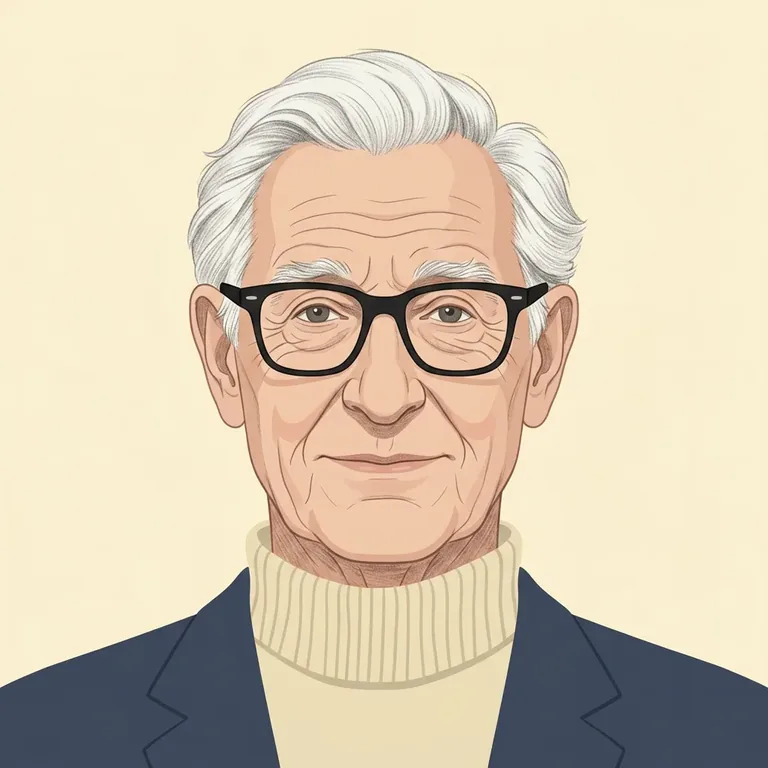
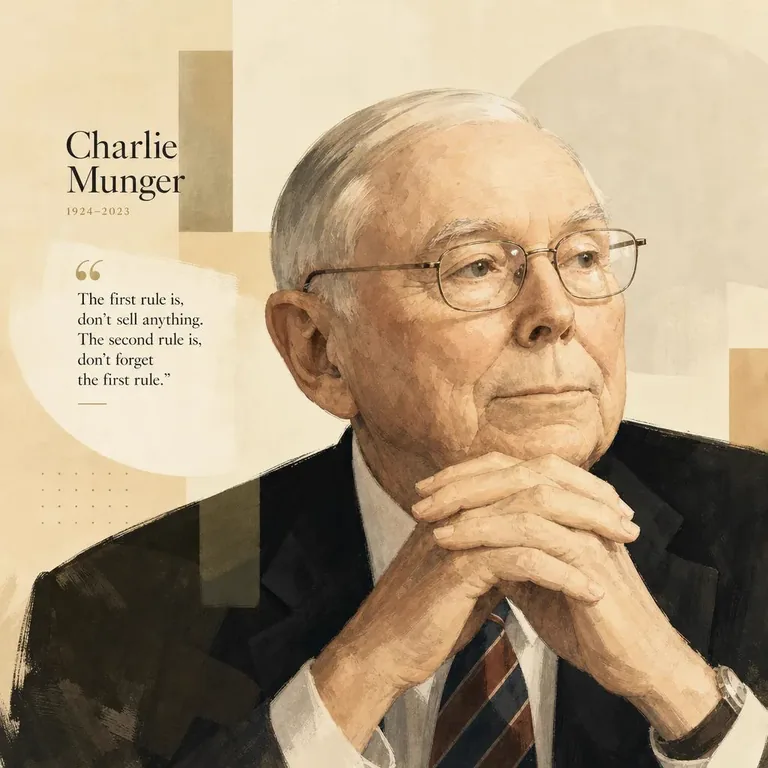
Vice Chairman, Berkshire Hathaway.
The intellectual sparring partner who turned Berkshire from a Graham-style cigar-butt shop into the world's most patient compounder — by insisting that great businesses, bought rarely, beat clever ones bought often.
Every story has the highlights. This is the boring middle, the doubts, and the moments that quietly changed everything.
Grew up six blocks from a young Warren Buffett's grandfather's grocery store, where he worked weekends as a boy.
A modest Midwestern childhood with no obvious path to capital.
Where you start is mostly noise; what you read and who you choose matters far more.
Dropped out of the University of Michigan at 19 to serve as a meteorologist during WWII.
Service interrupted formal education; he never earned an undergraduate degree.
Credentials are optional. Curiosity isn't.
Admitted without a bachelor's degree after the dean of his late father's class made an exception.
Had to prove he belonged at Harvard with no undergraduate credential.
When the door is closed, find someone who remembers your family.
A mutual friend introduced them; they talked for hours and became lifelong intellectual partners.
Munger was a corporate lawyer in California with no investing track record.
One conversation can re-route a life. Stay in rooms with smarter people.
Ran a concentrated partnership from 1962 to 1975, compounding at ~20% annually while running a law firm.
Splitting attention between a demanding legal practice and investing.
Concentration plus patience beats diversification plus activity.
Persuaded Buffett to pay 3x book value for a quality business — a heretical move for a Graham disciple.
See's was 'expensive' by every Graham metric Buffett had used for two decades.
A great business at a fair price beats a fair business at a great price.
Returned capital after a brutal 1973–74 drawdown and joined Buffett full-time at Berkshire.
Accepting that investing as a stand-alone career had run its course.
Know when to stop a good game to play a better one.
Became Buffett's official second-in-command and the loudest internal voice against bad ideas.
Defining a role that complemented, not duplicated, a once-in-a-century investor.
Be the abominable no-man. Subtraction is leverage.
Gave a Harvard talk cataloguing 25 cognitive biases — a foundational text for modern behavioral investing.
Synthesizing psychology, economics, and biology into one usable framework before behavioral finance was mainstream.
Borrow the best ideas from every discipline. Don't be a one-trick mind.
A 500-page collection of his speeches and mental models edited by Peter Kaufman — required reading for serious investors.
Letting his private thinking become a public canonical text.
Teach what you've learned. Compound your wisdom in other minds.
Ran the small-cap publisher and used its annual meeting as a second forum after Berkshire's.
Maintaining intellectual sharpness into his late 80s and 90s.
Stay in the game. The mind atrophies without problems to solve.
Worked at Berkshire and Daily Journal almost to the end; his final interview was published days before his death.
Building a partnership designed to outlive him.
The longest compounder is a life of learning, not a portfolio.
Skills aren't talents — they're the residue of a thousand decisions. Here is what compounded over a lifetime.
Built a latticework of ~100 big ideas from psychology, biology, math, physics, and history — and checked every decision against many of them.
Decades of reading 3–4 books a week across every discipline; refusing to specialize.
Started every problem by asking what would make it fail — then worked to avoid those things first.
Borrowed from Jacobi's mathematics: 'Invert, always invert.' Applied it to law, investing, and life.
Sat on cash for years waiting for the rare obvious bet, then concentrated heavily when it arrived.
Survived multiple drawdowns by treating inactivity as a position, not a failure.
Distilled complex business analysis into one-line aphorisms a 12-year-old could remember.
Practiced at Berkshire annual meetings — answering hundreds of questions in front of 40,000 people each year.
Played the 'abominable no-man' at Berkshire — saying no to almost everything so the yeses could be big.
Years as a deal lawyer trained him to spot what kills a transaction before it closes.
Read continuously — biographies, science, history — as the cheapest form of borrowed experience.
Lifelong habit; said his children called him 'a book with legs sticking out.'
Stayed cheerful through bear markets, lawsuits, and personal tragedy. Never panicked publicly.
Survived the death of a young son to leukemia in 1955; said the experience hardened his emotional discipline.
No journey is a straight line. The setbacks weren't detours — they were the route.
His partnership lost ~32% in 1973 and ~31% in 1974 during the brutal bear market.
Held positions, didn't panic-sell, and recovered fully by 1976 before winding the fund down on his own terms.
If you can't handle a 50% drawdown twice a century, you shouldn't be in equities.
Wesco was a small S&L holding company during the industry's collapse; many peers went bankrupt.
Aggressively de-risked early, sold most thrift assets, and pivoted Wesco into insurance and equity investments.
When the whole industry is sick, get out before the diagnosis.
Bought Alibaba at Daily Journal, doubled down as it fell, then partially sold at a loss after Chinese regulatory crackdowns.
Publicly admitted the misjudgment of Chinese political risk — a rare public reversal at age 98.
Even great frameworks fail when the political ground beneath the company moves.
Refused to invest in software and internet businesses through the 1990s and 2000s — missed Amazon, Google, Microsoft, early Apple.
Eventually drove Berkshire's massive Apple position (now a multi-hundred-billion-dollar holding) in his 90s.
Your circle of competence can grow late. Stay willing to update.
The books on the shelf, the people they studied, the ideas they kept returning to.
Peter Kaufman (ed.)
The canonical Munger anthology — speeches, mental models, the human misjudgment talk.
Janet Lowe
The most thorough Munger biography, written with his cooperation.
Robert Cialdini
Munger called it required reading and sent Cialdini Berkshire shares as thanks.
Bryan Caplan
One of his late-life recommendations on rational decision-making at the personal level.
Herbert Simon
Munger admired Simon's bounded-rationality work and recommended this memoir often.
Jared Diamond
Cited as an example of cross-disciplinary thinking done right.
Interviews, keynotes, talks, and documentaries — chosen for the moments that reveal how they actually thought.
The bets that, made differently, would have written a different life.
AI-distilled takeaways, sorted by who you are and what you're building toward.
If you can't find a great opportunity, do nothing. Cash is a position.
Don't ask how to succeed — list the ways you'd fail, then avoid them.
Read across disciplines. Specialists miss obvious things generalists catch.
Subtraction is leverage. The best decisions are the ones you don't make.
They are losing strategies that destroy compounders far worse than bear markets.
Children watch what you do, not what you say. Live the lesson.
Long careers compound on trust. Never trade reputation for a fee.
The questions most people have after studying this life. Tap one — every answer is built from Charlie Munger's own timeline, decisions, books, and lessons on this page.
Adjacent journeys, a collection that frames the craft, and one pick from a different world.

An Omaha paperboy who turned a failing New England textile mill into the world's most patient compounding machine, and along the way wrote the most-quoted shareholder letters in business history.
Read Journey
Built the world's largest hedge fund by codifying decision-making itself — turning radical transparency, idea meritocracy, and written principles into an operating system for thinking under uncertainty.
Read Journey
The psychologist who proved economists wrong about rationality — and gave the world a vocabulary for the two systems running in every human head.
Read Journey
A Compton, California prodigy coached by her father on public courts who became the most decorated tennis player of the Open era — and rewrote what a global athlete brand can look like.
Read Journey


Capital allocators who treat investing as a craft of patience, judgment, and compounding — and rewrote the rules of how money is put to work.
Open Collection
Co-founder of Airbnb
Three air mattresses and a designer's eye that turned strangers into hosts — a founder who treats hospitality as a craft and product as the story.
Open Journey