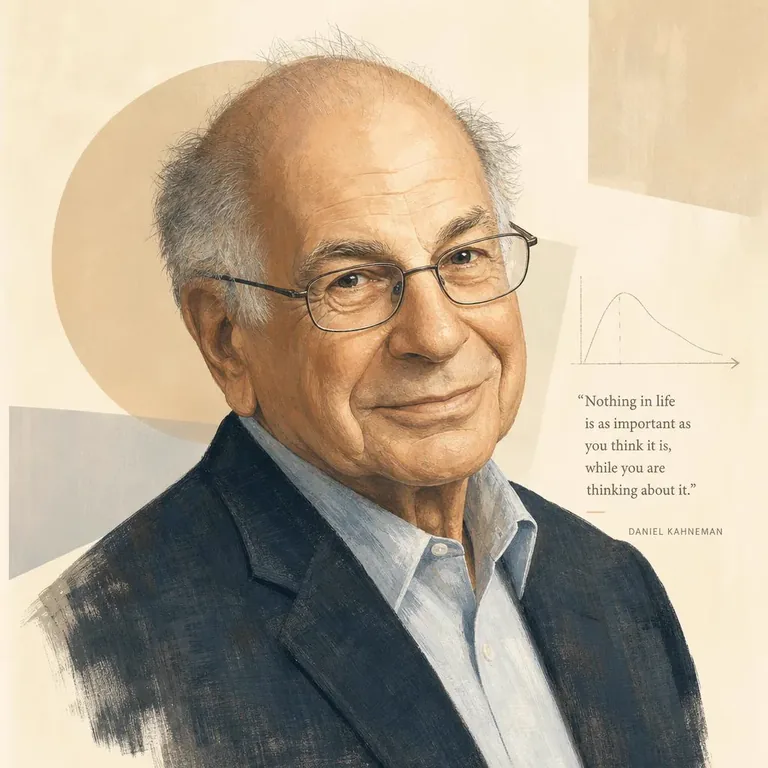
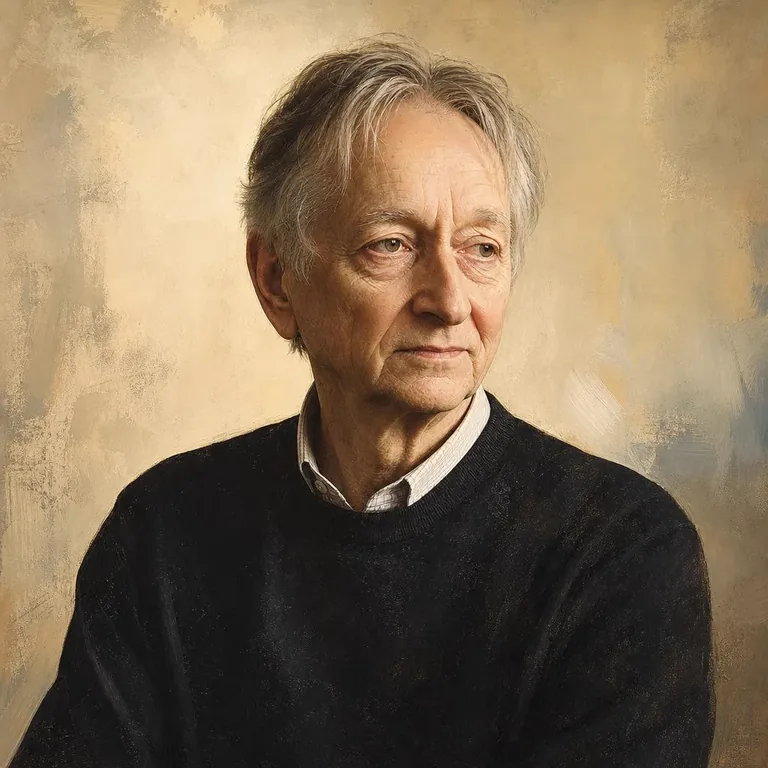
Illustrated portrait of Daniel Kahneman
Journey
A life, end to end

Daniel Kahneman

Nobel Laureate, Founder of Behavioral Economics.

The psychologist who proved economists wrong about rationality — and gave the world a vocabulary for the two systems running in every human head.

Birth Year
1934
Industry
Psychology & Behavioral Economics
Country
United States (born Tel Aviv)
Key Achievement
Won the 2002 Nobel Prize in Economics (as a psychologist) for prospect theory — the work with Amos Tversky that founded behavioral economics.
Life Timeline

The full arc, year by year.

Every story has the highlights. This is the boring middle, the doubts, and the moments that quietly changed everything.

  1. 1934

    Born in Tel Aviv, raised in Paris

    Lithuanian Jewish family living in occupied France; his father was briefly held in a deportation camp.

    Challenge

    Spent his childhood hiding from the Nazis, moving between safe houses in rural France.

    Lesson

    Early exposure to human cruelty made the study of human judgment a personal mission.

  2. 1948

    Moved to newly founded Israel

    Family emigrated to British Mandate Palestine just before the State of Israel was declared.

    Challenge

    Starting over again in a third language and a country at war.

    Lesson

    Identity is what you carry, not what you leave behind.

  3. 1954

    Drafted as a psychologist in the IDF

    Designed the personality assessment system used by the Israeli military to evaluate officer candidates.

    Challenge

    At 20, redesigning the methodology used to evaluate every Israeli officer for decades.

    Lesson

    Sometimes your most lasting work happens before anyone considers you an expert.

  4. 1961

    Earned PhD from UC Berkeley

    Studied perception and cognition; returned to Hebrew University as a junior faculty member.

    Challenge

    Bridging the rigor of American experimental psychology with Israeli academic life.

    Lesson

    Train abroad, build at home. The combination is harder to replicate.

  5. 1969

    Met Amos Tversky in Jerusalem

    Tversky gave a guest lecture; Kahneman pushed back hard. They went for coffee and started a 30-year collaboration.

    Challenge

    Two brilliant, opinionated people learning to think jointly without either dominating.

    Lesson

    The most productive partnerships are intellectually equal and emotionally generous.

  6. 1974

    Published 'Judgment Under Uncertainty' in Science

    The paper that introduced cognitive heuristics — availability, representativeness, anchoring — to the broader scientific world.

    Challenge

    Convincing economists that humans aren't the rational agents their models assumed.

    Lesson

    If your field's foundational assumption is wrong, document it precisely.

  7. 1979

    Published 'Prospect Theory' in Econometrica

    Showed how people actually weight gains and losses asymmetrically — the foundation of behavioral economics.

    Challenge

    Getting a psychology paper accepted in a top economics journal in 1979.

    Lesson

    Bridge disciplines by submitting your best work to the harder field's journal.

  8. 1996

    Death of Amos Tversky

    Lost his closest collaborator to melanoma; the 30-year partnership ended just as their work was reaching mainstream acceptance.

    Challenge

    Continuing the research and the public role alone.

    Lesson

    Build collaborations that can carry the field forward even when one of you is gone.

  9. 2002

    Awarded Nobel Prize in Economics

    Won for prospect theory — and used the Nobel speech to publicly credit Tversky, who would have shared it.

    Challenge

    Receiving an economics Nobel as a psychologist who had never taken an economics class.

    Lesson

    Honors find work that the field couldn't ignore. Keep producing that kind of work.

  10. 2011

    Published 'Thinking, Fast and Slow'

    His 500-page summary of a career's research; became one of the best-selling psychology books ever written.

    Challenge

    Compressing decades of technical work into a book for general readers.

    Lesson

    The best summary of your work is written by you, in your 70s.

  11. 2021

    Published 'Noise' with Sibony and Sunstein

    Extended his framework from individual bias to system-level noise in decisions like medical diagnosis and judicial sentencing.

    Challenge

    Convincing experts that random variability in their judgments was as dangerous as systematic bias.

    Lesson

    Even a famous framework deserves an upgrade. Don't stop at one big idea.

  12. 2024

    Died at 90 in Switzerland

    Reported to have chosen assisted death in Switzerland; spent his final years writing and teaching.

    Challenge

    Choosing how to leave on his own terms.

    Lesson

    How you end is part of the work. Decide it before others decide it for you.

Skills Acquired

What they learned to do well.

Skills aren't talents — they're the residue of a thousand decisions. Here is what compounded over a lifetime.

Experimental Design

Mastered

Crafted simple paradigms (the Linda problem, framing effects) that revealed deep cognitive structure.

How it developed

Years of Israeli military assessment work taught him to design tests that revealed real judgment, not impressed people.
Intellectual Partnership

Mastered

Worked alongside Amos Tversky for 30 years in true co-authorship — neither could later separate whose idea was whose.

How it developed

Daily conversations in Jerusalem coffee shops where ideas were drafted out loud and rewritten together.

Cross-disciplinary Translation

Mastered

Made cognitive psychology legible to economists, doctors, lawyers, and the general public.

How it developed

Forced himself to publish in target-discipline journals rather than psychology venues alone.

Intellectual Honesty

Mastered

Publicly disavowed his own priming-effect chapter in 'Thinking, Fast and Slow' when replication failed.

How it developed

Modeled after Karl Popper's standard: a theory survives by surviving attempts to kill it.

Long-Form Synthesis

Mastered

Held an entire field's worth of evidence in mind and rendered it as a single coherent narrative.

How it developed

Five years of writing 'Thinking, Fast and Slow' in his 70s.

Teaching

Mastered

Mentored generations of researchers including Richard Thaler, who built behavioral economics as a sub-field.

How it developed

Decades of seminars at Hebrew University, Berkeley, and Princeton.

Failures & Challenges

The chapters most pages skip.

No journey is a straight line. The setbacks weren't detours — they were the route.

Priming-effects chapter in 'Thinking, Fast and Slow' (2011)

Context

Devoted a chapter to social-priming research that subsequently failed widespread replication attempts.

Recovery

Publicly retracted his confidence in the chapter, wrote letters to lead researchers, and called the priming literature 'a train wreck.'

Lesson

Publicly walk back your own claims when the evidence turns. Your reputation survives. Your authority grows.

Early hedonic-adaptation framework

Context

His earlier work suggested humans return to baseline well-being after major life events; later evidence showed this was overstated.

Recovery

Updated his views and incorporated the criticism into later well-being research.

Lesson

Even your most cited finding deserves the same scrutiny you apply to others.

Underweighting the role of luck in expertise (early career)

Context

Early frameworks gave too much weight to deliberate practice and too little to environmental noise.

Recovery

The book 'Noise' (2021) was partly his correction — taking variability seriously as an equal partner to bias.

Lesson

The next book is often the answer to your previous book's blind spot.

Books & Resources

The library that shaped them.

The books on the shelf, the people they studied, the ideas they kept returning to.

Thinking, Fast and Slow

Daniel Kahneman

His canonical summary; required reading for anyone making decisions for a living.

Noise

Daniel Kahneman, Olivier Sibony, Cass Sunstein

Extends his framework from bias to unwanted variability in expert judgments.

The Undoing Project

Michael Lewis

Narrative account of the Kahneman–Tversky partnership; the best introduction to the people behind the ideas.

Misbehaving

Richard Thaler

Kahneman's protégé telling the founding story of behavioral economics from the inside.

Nudge

Richard Thaler & Cass Sunstein

The applied version of Kahneman's research — how design choices reshape behavior.

Videos & Documentaries

Watch them in their own words.

Interviews, keynotes, talks, and documentaries — chosen for the moments that reveal how they actually thought.

Key Decisions

The forks in the road.

The bets that, made differently, would have written a different life.

Partnering with Tversky (1969)

Risk · Low
Why
Saw an intellectual equal who pushed his thinking sharper.
Outcome
Thirty years of joint work that founded behavioral economics.
Long-term impact
Modeled what real co-authorship can produce.

Submitting Prospect Theory to Econometrica (1979)

Risk · Medium
Why
Wanted economists to engage the work on their own turf, not dismiss it as psychology.
Outcome
Acceptance in a top economics journal that put behavioral economics on the map.
Long-term impact
Created the bridge between two disciplines that had ignored each other.

Spending five years writing 'Thinking, Fast and Slow' (2006–2011)

Risk · Low
Why
Believed the field needed a synthesis a non-academic could read.
Outcome
Became one of the most influential popular science books of the century.
Long-term impact
Mainstreamed cognitive biases into general culture, journalism, and management.

Publicly disavowing the priming chapter (2017)

Risk · Medium
Why
Couldn't endorse research the replication evidence no longer supported.
Outcome
Strengthened his credibility and reshaped how the field handled replication failures.
Long-term impact
Modeled how to admit error at the height of fame.

Writing 'Noise' at 87

Risk · Low
Why
Saw that variability in judgment was an under-studied counterpart to bias.
Outcome
Extended the framework that defined his career.
Long-term impact
Showed that great frameworks deserve a second book, not a sequel.
What Can You Learn?

Take the lesson, not just the story.

AI-distilled takeaways, sorted by who you are and what you're building toward.

For Decision-makers

We have two systems: fast and intuitive, slow and deliberate.

Decide which system the question deserves before answering it.

For Managers

Replace judgment with rules when stakes are high and feedback is noisy.

A simple algorithm often beats a smart expert. Use checklists.

For Investors

Losses hurt about twice as much as gains feel good.

Risk tolerance is asymmetric. Design portfolios for the feeling, not the spreadsheet.

For Researchers

Replication is a feature, not an insult.

Treat failed replications as data, not attacks. Update fast.

For Anyone

Nothing in life is as important as you think it is while you are thinking about it.

The focusing illusion warps every plan. Step back before deciding.

For Hiring managers

Interview noise destroys hiring quality.

Score structured criteria separately and average them; don't form a holistic judgment.

For Forecasters

Take the outside view first.

Look at base rates for similar projects before trusting your inside-the-project optimism.

Questions People Ask

Questions people ask about this journey.

The questions most people have after studying this life. Tap one — every answer is built from Daniel Kahneman's own timeline, decisions, books, and lessons on this page.

Continue Exploring

Don't stop here.

Adjacent journeys, a collection that frames the craft, and one pick from a different world.