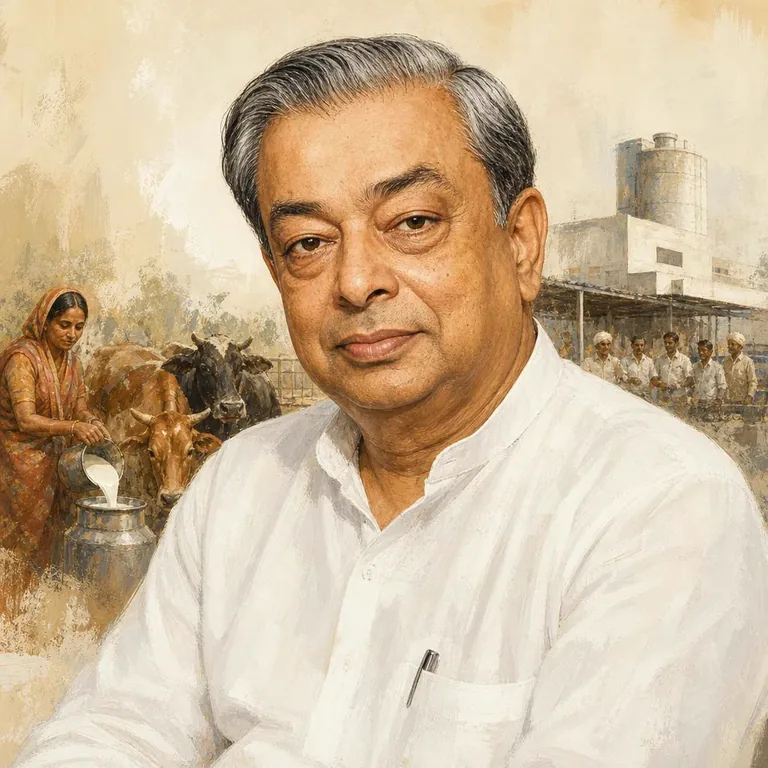
Cooperative Design
MasteredEngineered a three-tier village–district–state structure that gave farmers ownership, voice, and a share of every rupee.
Decades of arguing with bureaucrats, donors, and middlemen for one principle: producer ownership.
Father of the White Revolution; Founder, Amul.
The engineer who turned India from a milk-deficient country into the world's largest milk producer — by handing the dairy back to the farmers who actually milked the cows.
Every story has the highlights. This is the boring middle, the doubts, and the moments that quietly changed everything.
Son of a civil surgeon; grew up in a Syrian Christian family that valued education above all else.
Expected to follow his father into medicine, a path he had no taste for.
An obvious career is not always your career.
Studied metallurgical and nuclear engineering — chosen because the scholarship demanded it, not because he wanted dairy.
Had to swap his dream of nuclear engineering for dairy engineering when the scholarship dictated.
Sometimes a forced detour becomes the work of your life.
The government sent him to a dusty creamery in Anand to repay his scholarship bond — he hated it from day one.
Marooned in a small town doing work he did not choose, in an industry he did not care about.
Where you start does not have to be where you stay — but pay your dues first.
A local farmers' cooperative asked him to stay on and help them fight the exploitative Polson dairy. He agreed for six months. He stayed 60 years.
Choosing a tiny farmer cooperative over a clear government engineering career.
Some problems pick you. Recognize them when they do.
Western dairy science said milk powder could only be made from cow's milk. He and H.M. Dalaya proved it could be made from buffalo milk — unlocking India's actual supply.
The world's dairy experts said it was scientifically impossible.
Foreign expertise often encodes foreign constraints. Re-derive from first principles.
Prime Minister Lal Bahadur Shastri visited Anand, spent a night in a farmer's home, and asked Kurien to replicate the Anand model across India.
Scaling a single-district cooperative to a nation of 500 million.
Spend a night with the people you serve before designing for them.
Used surplus European milk powder as seed capital to build village dairy cooperatives across India — a 26-year programme.
Aid-funded programmes usually create dependence; he had to design for the opposite.
Aid is acceptable only if it builds the institution that will end the need for aid.
Federated the village cooperatives into a marketing body that owned the brand and the surplus — the farmers, not middlemen.
Convincing 700,000 illiterate farmers to trust a marketing federation they did not understand.
If the producer doesn't own the brand, someone else will own the producer.
Built a graduate school to produce managers who would actually live and work in villages.
India's best graduates wanted Bombay and Delhi, not Anand.
If the talent won't come to the problem, build a school that grows it locally.
Recognised internationally as the architect of the world's largest agricultural development programme.
Staying focused on Indian farmers despite the pull of global consulting roles.
International recognition is a distraction unless it serves the people you started with.
Overtook the United States — entirely through smallholder cooperatives, not industrial farms.
Defending the cooperative model against waves of privatization pressure from the 1990s onward.
Scale built on dignity outlasts scale built on extraction.
Political and internal pressures pushed him out of the federation he had built; he resigned in protest.
Watching institutional politics take over an institution built on trust.
Institutions outlive their founders only if the founders let them — and even then, sometimes painfully.
Buried in the town he had refused to leave for six decades; Amul revenues had crossed ₹13,000 crore.
Building something designed to outlast a single charismatic leader.
A life's work is measured by what continues after you stop.
Skills aren't talents — they're the residue of a thousand decisions. Here is what compounded over a lifetime.
Engineered a three-tier village–district–state structure that gave farmers ownership, voice, and a share of every rupee.
Decades of arguing with bureaucrats, donors, and middlemen for one principle: producer ownership.

Founded NDDB, GCMMF, IRMA — bodies designed to function long after he was gone.
Watched colonial institutions hollow out at Independence and resolved to build replacements with deeper roots.
Extracted aid, autonomy, and protection from a regulation-heavy government — without becoming an arm of it.
Cultivated direct relationships with prime ministers from Nehru to Vajpayee while refusing political office.
Solved the buffalo-milk-powder problem that Western dairy science said was impossible.
Brought metallurgical training to dairy: assume nothing about materials until you test them yourself.
Turned Amul from a regional cooperative into one of India's most loved consumer brands through the Amul Girl campaign.
Hired ad agency ASP in 1966 and protected the campaign's editorial freedom for 60 years.
Could walk into any village in Gujarat and be received as one of their own — earned, not inherited.
Lived in Anand his entire career, attended cooperative meetings personally, ate in farmer homes.
No journey is a straight line. The setbacks weren't detours — they were the route.
Internal politics and the rise of professional managers pushed him out of GCMMF after 33 years as chairman.
Resigned publicly, refused to fight in court, focused his final years on writing and IRMA.
Even institution builders eventually become the institution's old guard. Plan succession before they plan it for you.
Tried to replicate the Amul model in edible oils through Dhara — never reached comparable scale or trust.
Acknowledged that the cooperative model worked best where the producer had a perishable product and no alternative buyer.
A successful template doesn't transfer — the underlying conditions have to be the same.
Despite enormous domestic scale, Amul never became a major global brand in his lifetime.
Prioritised farmer prices and domestic depth over export glamour — a deliberate trade-off.
Choose the trade-off, then stop apologising for what you traded away.
The books on the shelf, the people they studied, the ideas they kept returning to.
Verghese Kurien (with Gouri Salvi)
His autobiography — the canonical account of Operation Flood told in his voice.
Verghese Kurien
Earlier memoir focused on the institutional fights behind Amul's growth.
M.V. Kamath
The most thorough Kurien biography, with rich detail on the political battles.
Shanti George
Academic account of the policy and economics behind the programme.
B.M. Vyas
Insider analysis from a long-serving GCMMF managing director.
Interviews, keynotes, talks, and documentaries — chosen for the moments that reveal how they actually thought.
The bets that, made differently, would have written a different life.
AI-distilled takeaways, sorted by who you are and what you're building toward.
If the people who make the product also own the brand, no middleman can dismantle it.
Spend aid on capacity, not consumption — or stop spending it.
Buffalo-milk powder was solved in two years; cooperative trust took thirty.
Sixty years in Anand bought him credibility no consultant could rent.
They are a market, a workforce, and a school of management — if you let them be.
He wanted to be a nuclear engineer. He became the father of the white revolution. He let it happen.
The questions most people have after studying this life. Tap one — every answer is built from Verghese Kurien's own timeline, decisions, books, and lessons on this page.
Adjacent journeys, a collection that frames the craft, and one pick from a different world.

The socialist-turned-capitalist who founded Infosys with ₹10,000 from his wife's savings, ran it on a code of 'compassionate capitalism', and built the institution that proved Indian software belonged on the world stage.
Read Journey
The quiet industrialist who took an aging family conglomerate and turned it into India's first true global corporation — acquiring Jaguar Land Rover, Tetley, and Corus while building the world's cheapest car.
Read Journey
A Stanford symbolic-systems engineer who joined Google as employee 20, owned its consumer products through hypergrowth, and then took on the hardest turnaround in consumer internet at Yahoo.
Read Journey
The Denny's busboy who bet thirty years on parallel computing — and turned a 1990s graphics card maker into the most strategically important company of the AI era.
Read Journey


Founders who were fired, rejected a hundred times, or three failed launches from bankruptcy — and the route they took back.
Open CollectionThree years building a tool nobody asked for, financed by my parents' savings. The post-mortem was harder than the shutdown.
Read Story
Co-founder of Airbnb
Three air mattresses and a designer's eye that turned strangers into hosts — a founder who treats hospitality as a craft and product as the story.
Open Journey