Affordance Theory
MasteredPopularized Gibson's concept of affordances and applied it to interface design.
How it developed
Decades synthesizing perception research with applied design.
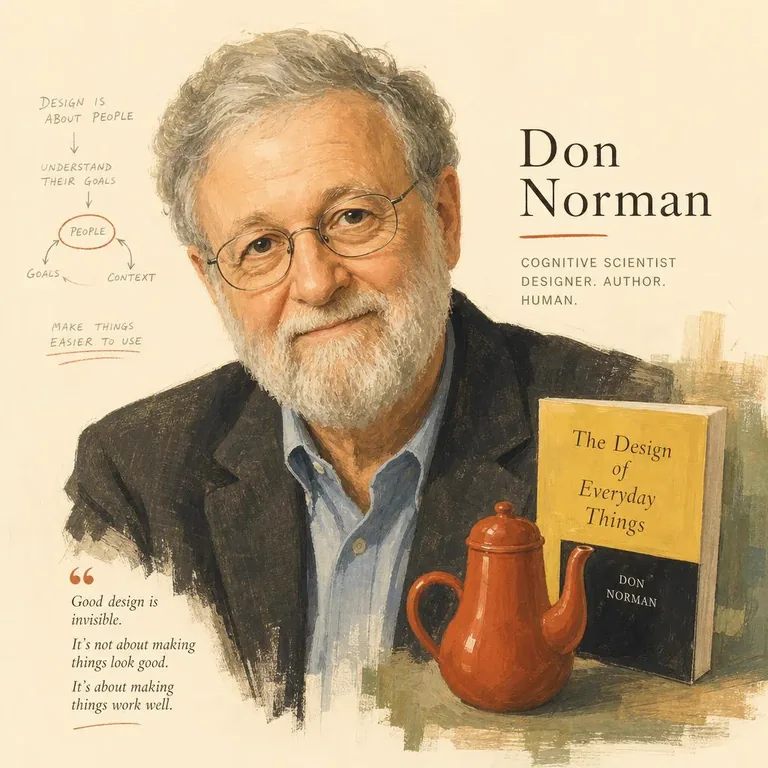
Cognitive Scientist; Author of 'The Design of Everyday Things'.
Coined 'user experience' and built the field — by insisting that confusing doors and broken stovetops were design failures, not user failures, and that cognition is what design actually serves.
Every story has the highlights. This is the boring middle, the doubts, and the moments that quietly changed everything.
Raised in Los Angeles in an academic-leaning family that prized engineering.
Choosing between engineering and psychology, two divergent paths.
The most interesting careers refuse to choose between disciplines.
Studied EE at MIT during the dawn of modern computing.
EE was a strict discipline; psychology was off the syllabus.
Get the formal training before you cross into the field you actually want.
Switched from engineering to mathematical psychology under Duncan Luce.
Justifying the switch to advisors who saw the move as career suicide.
Career moves that confuse mentors often turn out to be the most leveraged.
Co-founded the cognitive science department, one of the first in the world.
Building a discipline that didn't yet have textbooks.
Pioneer fields require institution-building, not just research.
With Stephen Draper, formalized the discipline of user-centered design.
Convincing engineers that users came first.
Naming a movement is half of starting it.
Originally titled 'The Psychology of Everyday Things'; reframed bad design as a public-health issue.
Selling cognitive science to a general audience.
A clear book outlasts a hundred papers.
Coined the title that defined a generation of design jobs.
Building UX inside Apple's engineering-led culture of the early 90s.
Job titles are taxonomy weapons; choose them with intent.
Led research across hardware, software, and HCI.
Defending long-horizon research during Apple's pre-Jobs near-death years.
Research budgets are the first to go when execs panic.
Launched a UX consulting and research firm with Jakob Nielsen.
Building demand for an emerging discipline among corporate clients.
If you want a discipline to mature, build the institution that defines its standards.
Expanded his framework: visceral, behavioral, reflective levels of design.
Squaring earlier 'usability' message with the role of beauty and meaning.
Update your framework publicly; consistency is overrated.
Founded the Design Lab at UCSD shortly after.
Building a design school inside an engineering university.
Design needs interdisciplinary homes; build them deliberately.
Late-career call for sustainable, humanity-centered design at planetary scale.
Reframing his own discipline as too focused on individual users.
It's never too late to admit your field needs to grow.
Skills aren't talents — they're the residue of a thousand decisions. Here is what compounded over a lifetime.
Popularized Gibson's concept of affordances and applied it to interface design.
Decades synthesizing perception research with applied design.
Wrote textbooks that read like trade books and trade books that taught psychology.
Dozens of revisions; he rewrites obsessively.
Codified the methods — observation, contextual inquiry, usability testing — that became standard UX practice.
Decades of empirical lab work, then consulting with global brands.
Could pull a discipline-spanning framework from a stack of papers in days.
Trained as a cognitive scientist before specialization narrowed the field.
Founded departments, labs, and a consultancy that gave UX its credentials.
Five decades of academic and corporate institution work.
Made cognitive science feel like common sense for boardroom audiences.
Hundreds of corporate and conference talks.
Publicly updated his framework when new evidence demanded it.
Treated his books as living documents, not monuments.
No journey is a straight line. The setbacks weren't detours — they were the route.
Joined Apple at a turbulent moment when research budgets were unstable.
Used the platform to build credibility, then left to start NN/g.
When an org won't fund the work, leave and fund it yourself.
'Design of Everyday Things' downplayed aesthetics — drew valid criticism.
Wrote 'Emotional Design' to integrate beauty into the framework.
Defend your worldview only as long as the evidence does.
Some academic colleagues criticized NN/g as commercializing the field.
Argued institutional consulting was the only way to scale standards.
Discipline-building requires unpopular institution-building.
Spent much of his career focused on individual user delight, not collective harm.
Published 'Design for a Better World' to reframe the discipline.
Frameworks need to expand to match the scale of their consequences.
The books on the shelf, the people they studied, the ideas they kept returning to.
Don Norman
The canonical UX text; revised and expanded in 2013.
Don Norman
His three-level framework: visceral, behavioral, reflective.
Don Norman
Why complexity is necessary and how to make it feel simple.
Don Norman
Late-career argument for humanity-centered, sustainable design.
Don Norman & Stephen Draper
The foundational academic anthology that named the field.
Don Norman
His take on automation and the human side of intelligent products.
Interviews, keynotes, talks, and documentaries — chosen for the moments that reveal how they actually thought.
The bets that, made differently, would have written a different life.
AI-distilled takeaways, sorted by who you are and what you're building toward.
Confusion costs lives in cockpits and emergency rooms — not just frustration.
Blame the artifact, then redesign it.
Naming the role shapes who you can hire and what they'll build.
A clear book outlasts a hundred citations.
Consistency is a vice when evidence has moved.
Notice the doors you push when they say 'pull'; that's design teaching you.
Departments and degrees mature a discipline faster than papers.
The questions most people have after studying this life. Tap one — every answer is built from Don Norman's own timeline, decisions, books, and lessons on this page.
Adjacent journeys, a collection that frames the craft, and one pick from a different world.
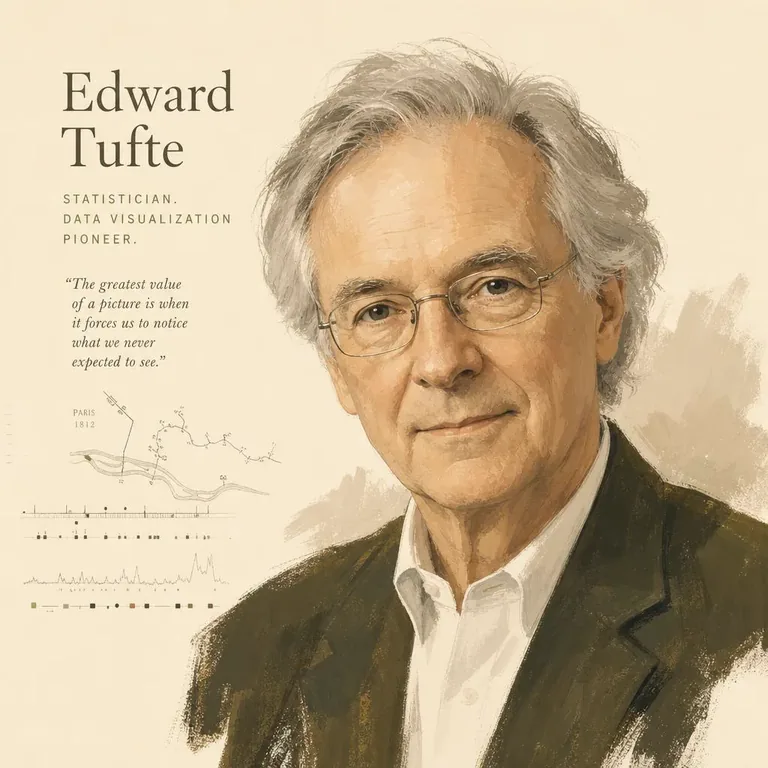
Treated charts as a form of moral seriousness — taught a generation that bad visualizations don't merely confuse, they kill, and built the standards that distinguish honest evidence from decorated noise.
Read Journey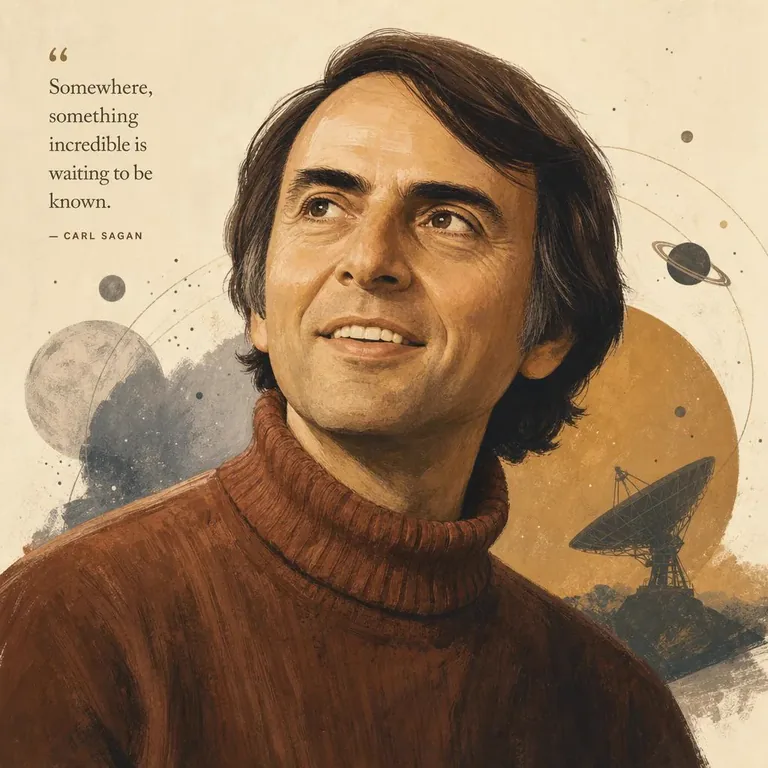
Built the most-watched science series in television history, talked to a planet about the Pale Blue Dot, and proved that rigorous astronomy and lyrical prose could share the same sentence — and the same career.
Read Journey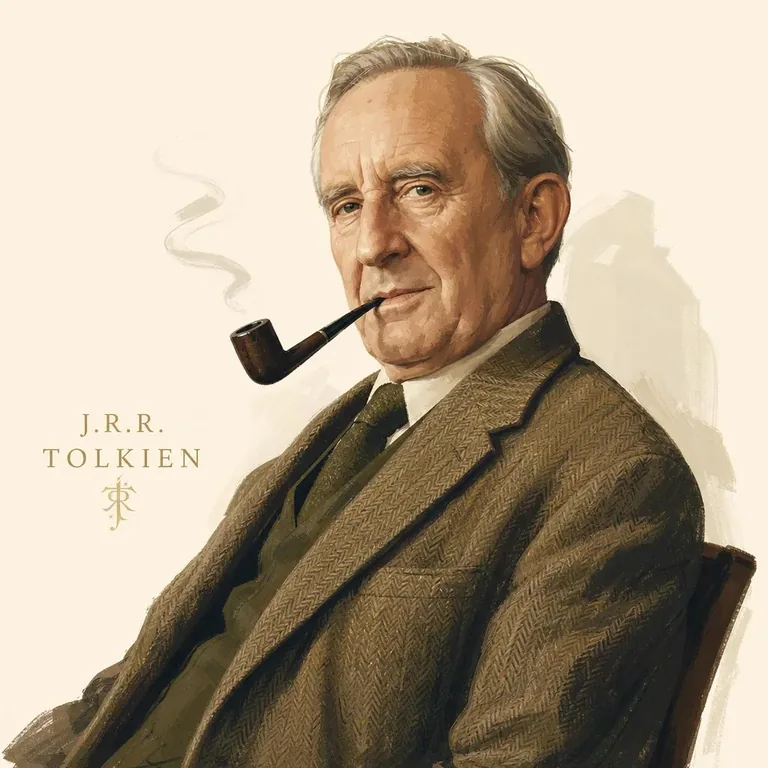
Invented languages first, then the world they would be spoken in — and proved that a single Oxford philologist, working evenings for forty years, could create the mythology a country didn't know it was missing.
Read Journey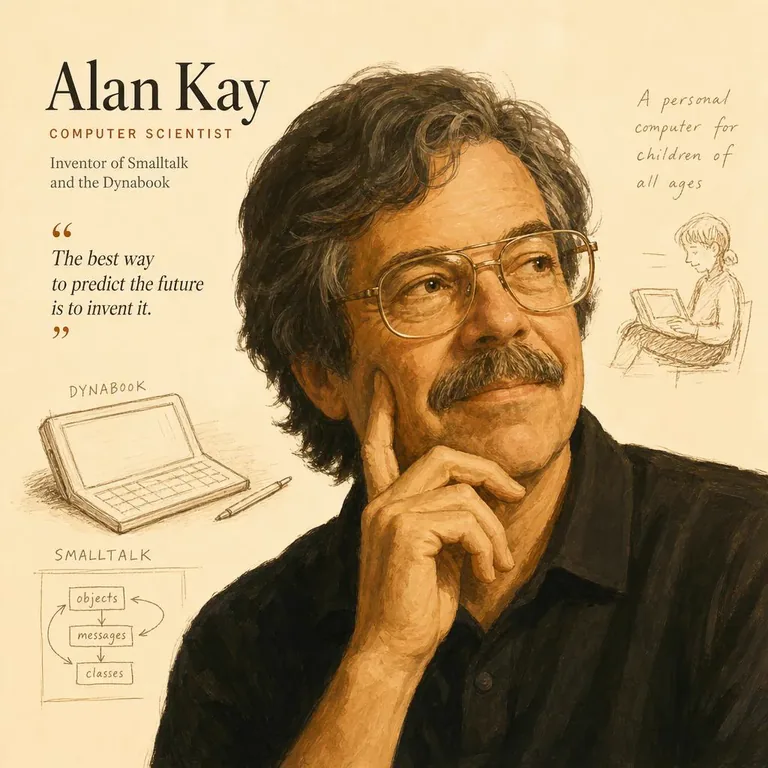
The computer scientist who imagined the laptop, the GUI, and object-oriented programming a decade before any of them existed — then spent his life pushing the rest of the industry to catch up to the children he was building it for.
Read Journey

Taste as a leadership discipline. Founders and operators who used design culture as a competitive moat.
Open CollectionI left a PhD program convinced I had failed at science. A classroom of fifteen-year-olds gave it back to me, slower and better.
Read StoryCo-founder of Canva
Teaching yearbooks in Perth that grew into a design tool for a billion people — proof that patient founders win the long game.
Open Journey