First-Principles Reasoning
MasteredStarted every problem by re-deriving rather than memorizing.
How it developed
Inherited from his father's daily walks of asking 'why?'
Nobel-winning physicist, teacher, and explainer.
A Brooklyn-born Nobel laureate who reformulated quantum electrodynamics, played bongos in the Caltech faculty band, cracked Los Alamos safes for sport, and taught millions to think like a physicist.
Every story has the highlights. This is the boring middle, the doubts, and the moments that quietly changed everything.
Son of a uniforms-salesman father who taught him to look for the principle behind the phenomenon.
Working-class family during the Depression.
A parent who asks 'why' relentlessly raises a scientist.
Studied mathematics, then switched to physics; lived in the library.
Choosing physics when most peers picked engineering.
The discipline you can't stop reading about is the right one.
Studied under John Wheeler; began the path-integral formulation of quantum mechanics.
Reformulating quantum mechanics as a 22-year-old grad student.
Foundational rewrites are easier before tradition has taught you the rules.
Recruited to Los Alamos at 24; led a computing group of human calculators.
Working on a weapon of mass destruction in his early twenties.
Every scientific career has at least one decision with permanent moral weight.
Lost his teenage sweetheart and wife days before the Trinity test.
Carrying personal grief through a national-security crisis.
Grief and work coexist — neither postpones the other.
Created the visual notation now used to teach particle interactions worldwide.
Convincing senior physicists his diagrams weren't a gimmick.
Visual notation can unlock decades of teaching gain.
Moved from Cornell to Caltech, where he stayed for the rest of his career.
Choosing teaching-heavy institution over pure research one.
Long careers reward picking the institution that fits your temperament.
Predicted nanotechnology decades before the field existed.
Speculating in public about a technology with no instruments yet.
Scientists can sketch futures the engineers will build a generation later.
Shared with Schwinger and Tomonaga for quantum electrodynamics.
Adjusting to celebrity attention while keeping research focus.
Prizes are a tax on attention; spend the year recovering from them.
Co-authored three-volume undergraduate textbook from his Caltech lectures.
Compressing the discipline into teachable form.
Teaching forces you to discover the parts you only thought you understood.
Demonstrated O-ring failure on live TV by dipping the rubber in ice water.
Navigating commission politics while maintaining scientific integrity.
A simple demo can outweigh thousands of pages of report.
Succumbed to cancer at age 69 with the line 'I'd hate to die twice. It's so boring.'
Working through illness on his final lectures.
A life of curiosity ends with curiosity intact.
Skills aren't talents — they're the residue of a thousand decisions. Here is what compounded over a lifetime.
Started every problem by re-deriving rather than memorizing.
Inherited from his father's daily walks of asking 'why?'
Invented the diagrams that compressed years of formalism into a sketch.
Forced to invent shortcuts during PhD work on QED.
Could explain rubber bands, fire, and magnets to anyone with curiosity.
Decades of undergraduate teaching and BBC interviews.
Followed any interesting problem — biology, Mayan glyphs, safe-cracking, bongos.
Treated curiosity as a daily practice, not a hobby.
Insisted on disclosing what could disprove a hypothesis.
Refined through Manhattan Project peer scrutiny and Challenger commission work.
Lectured with such physicality his classes became collector's items.
Years of refining his Caltech delivery; recorded and re-watched.
No journey is a straight line. The setbacks weren't detours — they were the route.
Spent his early 20s on a weapon that killed hundreds of thousands.
Refused to work on nuclear weapons after the war; spoke openly about the moral weight.
Some achievements are also failures; carry both.
Struggled for years with grief; bounced between Cornell and depression.
Moved to Caltech; rebuilt around teaching and a wider intellectual circle.
Change of place can be a legitimate intervention after loss.
Some of his autobiographical stories aged poorly on gender.
Some peers and family addressed them; the lesson belongs to readers separating the work from the man.
Heroes are partial; engage with the whole record.
The books on the shelf, the people they studied, the ideas they kept returning to.
Richard Feynman
Three-volume undergraduate text — still the gold standard.
Richard Feynman
Anecdotal autobiography that became a cult classic.
Richard Feynman
Collected essays and interviews on curiosity and method.
Richard Feynman
Includes his Challenger commission account.
James Gleick
Definitive biography.
Interviews, keynotes, talks, and documentaries — chosen for the moments that reveal how they actually thought.
The bets that, made differently, would have written a different life.
AI-distilled takeaways, sorted by who you are and what you're building toward.
Volunteer for the lecture nobody else wants — it'll expose what you don't know.
Start every hard problem by ignoring the literature for a week.
Replace jargon with the actual physical story; if you can't, you don't understand it.
Translate the conclusion into a five-minute physical demonstration.
Follow the next interesting thing even when it's outside your discipline.
Publish the failure modes alongside the results.
The questions most people have after studying this life. Tap one — every answer is built from Richard Feynman's own timeline, decisions, books, and lessons on this page.
Adjacent journeys, a collection that frames the craft, and one pick from a different world.
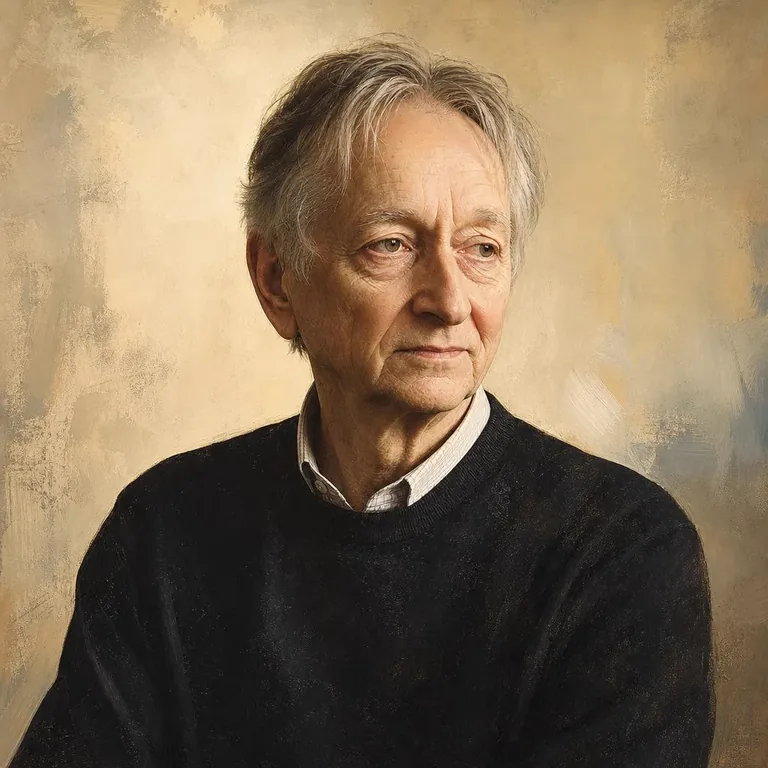
The cognitive scientist who spent forty years insisting that neural networks would work — through two AI winters, one Nobel Prize, and a final-act warning that they now might work too well.
Read Journey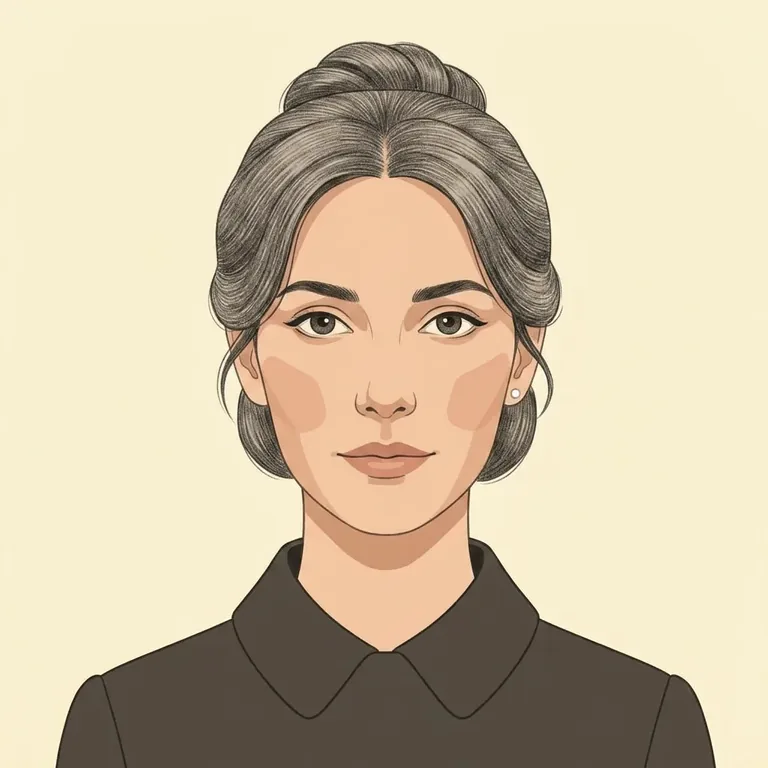
A Polish-born scientist who walked across Europe to study physics, discovered two new elements, won Nobel Prizes in two different sciences, and pushed open the door for every woman scientist who came after her.
Read Journey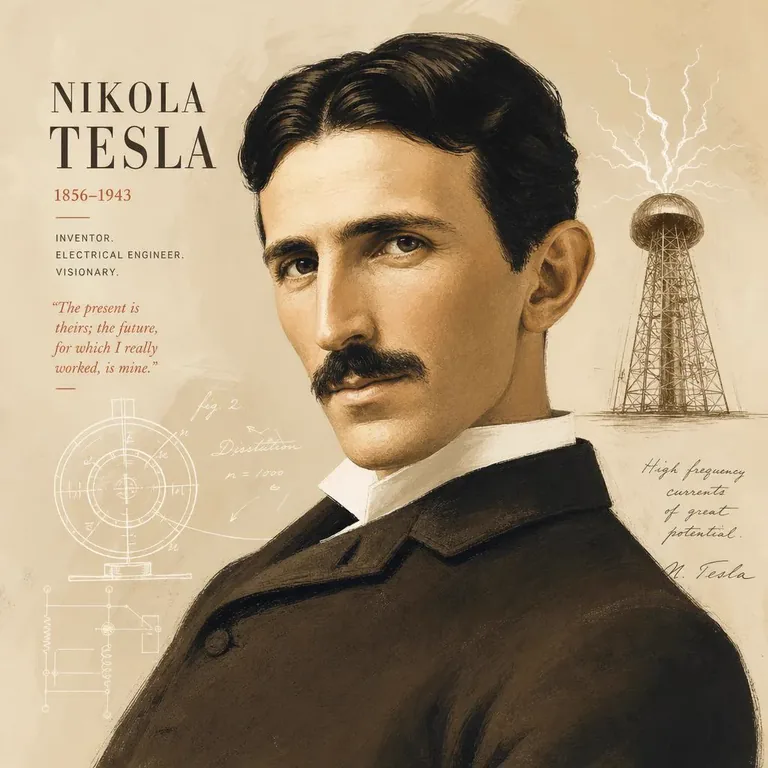
Imagined the alternating-current world we still live in — and proved that one engineer with the right model in his head could reshape the physical infrastructure of a planet, even while losing the business battles around it.
Read Journey
Built the most-watched science series in television history, talked to a planet about the Pale Blue Dot, and proved that rigorous astronomy and lyrical prose could share the same sentence — and the same career.
Read Journey
Researchers who reshaped what humans understand about the physical world — and how they teach the next generation to think.
Open CollectionFive years of submitting short fiction to magazines that mostly ignored me. The acceptance, when it came, was for the piece I almost didn't send.
Read Story
Co-founder of Airbnb
Three air mattresses and a designer's eye that turned strangers into hosts — a founder who treats hospitality as a craft and product as the story.
Open Journey